



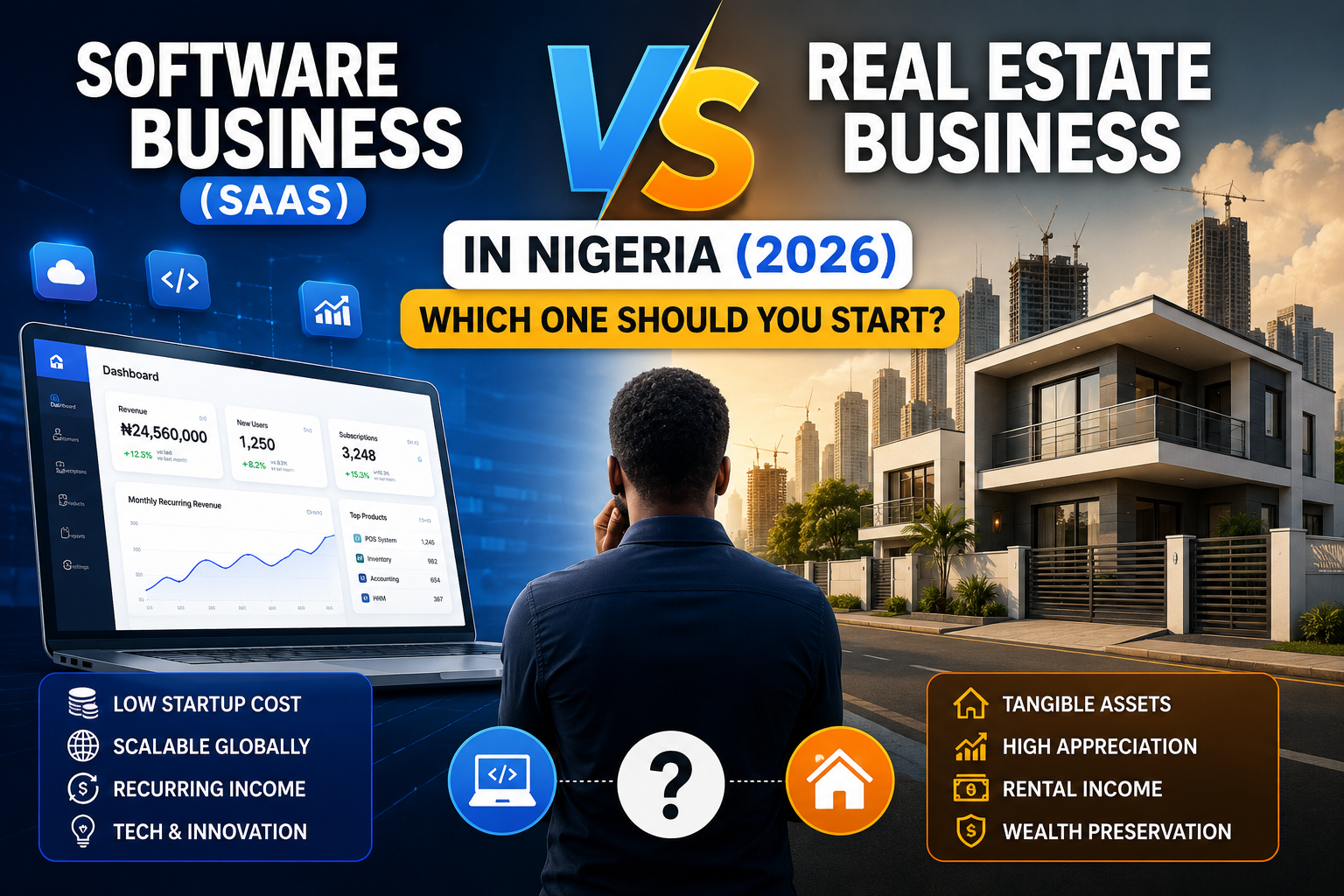
Nigeria’s business landscape is changing rapidly. The rise of artificial intelligence, digital payments, remote work, and online commerce has created new opportunities for entrepreneurs. At the same time, traditional sectors such as real estate continue to attract investors seeking stable and tangible assets.
One question many aspiring entrepreneurs are asking in 2026 is:
Should I start a Software as a Service (SaaS) business or invest in Real Estate?


Both industries have created millionaires and billionaires in Nigeria. Both sectors offer opportunities for wealth creation, passive income, and long-term growth. However, they require different skills, capital, risk tolerance, and business models.
In this comprehensive guide, we compare SaaS and Real Estate businesses in Nigeria in 2026, examining startup costs, profitability, scalability, risks, opportunities, and future prospects to help you make an informed decision.
Understanding the SaaS Business Model
Software as a Service (SaaS) is a software distribution model where users pay a recurring subscription fee to access software online.
Instead of buying software once, customers subscribe monthly or annually.
Popular examples include:
- Stocker ERP
- Audiomack
- Canva
- Zoom
- Slack
- Shopify
- HubSpot
In Nigeria, local SaaS businesses are emerging in sectors such as:
- Inventory Management
- School Management
- Hospital Management
- Hotel Management
- Accounting Software
- POS Systems
- HR and Payroll Systems
- Fintech Solutions
- Logistics Platforms
- E-commerce Management
Examples of successful Nigerian software companies include fintech startups, payment platforms, and business management software providers serving SMEs.
Understanding the Real Estate Business
Real estate involves buying, selling, leasing, developing, or managing properties.
The Nigerian real estate industry remains one of the largest sectors of the economy.
Real estate opportunities include:
- Land Banking
- Residential Housing
- Commercial Properties
- Short-Let Apartments
- Property Management
- Estate Development
- Real Estate Brokerage
- Construction Projects
- Property Flipping
Cities driving growth include:
- Lagos
- Abuja
- Port Harcourt
- Ibadan
- Kano
- Uyo
- Benin City
- Enugu
Nigeria’s housing deficit, estimated in the millions of units, continues to create demand for housing and property development.
SaaS vs Real Estate: Startup Capital Requirements
SaaS Startup Costs
One of the biggest advantages of SaaS is its relatively low entry barrier.
A startup founder can begin with:
- A laptop
- Internet connection
- Cloud hosting
- Development tools
- A small team
Typical startup costs:
Small SaaS Startup
- Domain and Hosting
- Development Tools
- Marketing
- MVP Development
Estimated Budget:
₦500,000 – ₦10 million
Medium SaaS Startup
- Developers
- UI/UX Designers
- Customer Support
- Digital Marketing
Estimated Budget:
₦10 million – ₦100 million+
Real Estate Startup Costs
Real estate generally requires significantly more capital.
Depending on location:
Land Investment
₦500,000 – ₦100 million+
Property Development
₦20 million – ₦5 billion+
Rental Apartments
₦50 million – ₦10 billion+
Estate Projects
₦500 million – ₦100 billion+
For many young entrepreneurs, access to capital remains the biggest barrier.
Winner: SaaS
SaaS wins in terms of affordability and accessibility.
Profit Potential Comparison
SaaS Profitability
A successful SaaS business can generate recurring revenue.
Example:
If you charge:
₦20,000 per month
And acquire:
1,000 customers
Monthly Revenue:
₦20 million
Annual Revenue:
₦240 million
The most attractive feature is that software can serve thousands of users without proportionally increasing costs.
This creates extremely high profit margins.
Many SaaS companies operate with margins exceeding 70%.
Real Estate Profitability
Real estate profits usually come from:
- Rent
- Property Appreciation
- Sales Commissions
- Development Projects
Example:
A property purchased for ₦20 million in 2022 may be worth ₦40 million or more in 2026.
Rental income also creates consistent cash flow.
However, profits tend to grow more slowly compared to successful software businesses.
Winner: SaaS
SaaS has significantly higher upside potential.
Scalability
SaaS Scalability
Software can be sold nationwide and globally.
A software company in Abuja can serve customers in:
- Lagos
- Accra
- Nairobi
- London
- Dubai
- New York
without opening physical offices.
This creates unlimited growth opportunities.
Real Estate Scalability
Real estate growth requires:
- More land
- More buildings
- More financing
- More staff
Expansion is capital intensive.
Winner: SaaS
SaaS is one of the most scalable business models in the world.
Risk Analysis
Risks of SaaS
Competition
Global software companies can enter your market.
Technology Changes
AI and emerging technologies can disrupt products quickly.
Customer Churn
Subscribers can cancel at any time.
Cybersecurity
Data breaches can damage trust and reputation.
Risks of Real Estate
Government Policies
Land regulations can change.
Documentation Issues
Nigeria still struggles with land title disputes.
Economic Downturns
Property sales may slow during economic crises.
Construction Inflation
Building material costs continue to rise.
Fraud
Fake land sales remain a major concern.
Winner: Draw
Both sectors carry significant but different risks.
Passive Income Potential
SaaS
Subscription revenue generates predictable monthly income.
Customers renew automatically.
Revenue compounds over time.
Real Estate
Rental properties provide stable recurring cash flow.
However:
- Maintenance costs
- Repairs
- Tenant management
can reduce profits.
Winner: SaaS
Well-run SaaS businesses often require less operational involvement after reaching scale.
Impact of Artificial Intelligence in 2026
AI is transforming every industry.
SaaS Benefits from AI
Modern software companies now integrate:
- AI Chatbots
- Predictive Analytics
- Workflow Automation
- Voice Assistants
- AI Customer Support
AI allows small software companies to compete with larger organizations.
Real Estate Benefits from AI
Real estate is also adopting:
- Smart Buildings
- Property Analytics
- Virtual Property Tours
- AI Valuation Models
However, AI creates more direct growth opportunities for software companies.
Winner: SaaS
AI is accelerating software innovation at an unprecedented pace.
Job Creation Potential
SaaS
Creates jobs for:
- Developers
- Designers
- Marketers
- Support Agents
- Product Managers
Real Estate
Creates jobs for:
- Architects
- Engineers
- Surveyors
- Builders
- Estate Agents
- Property Managers
Winner: Real Estate
Real estate generally creates more direct employment opportunities.
Long-Term Wealth Creation
Many investors prefer real estate because properties are tangible assets.
Land remains one of the oldest forms of wealth preservation.
However, software companies can create enormous enterprise value.
Consider global examples:
- Microsoft
- Salesforce
- Shopify
- Adobe
Many software founders become wealthy faster than property investors.
Winner: Depends on Your Goals
If you want:
- Asset ownership
- Long-term stability
Choose Real Estate.
If you want:
- Rapid growth
- Scalability
- High upside potential
Choose SaaS.
Why More Nigerian Entrepreneurs Are Choosing SaaS in 2026
Several trends are driving software adoption:
Digital Transformation
Businesses are moving online.
Smartphone Penetration
More Nigerians are connected than ever.
Cloud Computing
Infrastructure costs are lower.
AI Revolution
Software development is becoming faster.
Subscription Economy
Businesses prefer recurring software subscriptions.
SME Growth
Millions of Nigerian businesses need digital tools.
These factors create massive opportunities for software startups.
Why Real Estate Still Remains Attractive
Despite the growth of technology, real estate continues to thrive because:
- Nigeria’s population keeps growing.
- Housing demand remains high.
- Urbanization is increasing.
- Property values generally appreciate over time.
- Real estate serves as an inflation hedge.
For investors seeking stability, real estate remains difficult to ignore.
The Smartest Strategy in 2026
Many successful entrepreneurs are combining both industries.
A common wealth-building path looks like this:
Step 1
Build a SaaS business.
Step 2
Generate recurring subscription income.
Step 3
Use profits to acquire land and properties.
Step 4
Build a diversified portfolio.
This strategy allows entrepreneurs to benefit from both high-growth technology and stable asset ownership.
Final Verdict: SaaS vs Real Estate in Nigeria (2026)
If you are starting with limited capital, strong technical skills, and a desire to scale quickly, Software as a Service (SaaS) is likely the better opportunity in 2026.
If you have substantial capital, prefer tangible assets, and seek long-term stability, Real Estate remains an excellent investment.
Choose SaaS If:
- You have limited startup capital.
- You understand technology.
- You want global scalability.
- You are comfortable with innovation.
- You want recurring revenue.
Choose Real Estate If:
- You have access to significant capital.
- You prefer physical assets.
- You want long-term appreciation.
- You understand property markets.
- You prefer lower technological risk.
Conclusion
The future of entrepreneurship in Nigeria will likely be shaped by both technology and property investment. While real estate remains a powerful vehicle for preserving wealth, SaaS offers unmatched scalability, recurring revenue, and growth potential in an AI-driven economy.
For most young entrepreneurs in Nigeria in 2026, the better opportunity may not be choosing one over the other—but starting with SaaS to generate cash flow and eventually using those profits to build a real estate portfolio.
The entrepreneurs who combine digital innovation with physical asset ownership may ultimately create the greatest wealth over the next decade.